Your AC runs constantly, rooms stay stuffy, and energy bills keep climbing. In Poinciana's heat, that's leaky ductwork bleeding conditioned air into your attic before it reaches your living spaces.
Many homeowners believe that air duct sealing in Poinciana involves simply applying mastic paste to cover visible gaps. What actually happens involves pressure testing, thermal imaging, and sealing leaks you'll never see—flex duct collars that separated years ago, panned floor joists never sealed during construction, and return plenum gaps hidden behind drywall. We've learned that sealing systems across Solivita, Storey Grove, and Country Walk, where homes are losing the most conditioned air, rarely show obvious damage.
This checklist covers what professional air duct sealing in Poinciana actually includes—the realistic process that separates thorough work from surface-level patch jobs. Most Poinciana homes built in the last 15 years lose 25-40% of conditioned air through ductwork. The question isn't whether your ducts leak—it's whether the crew fixing them actually tests, accesses, and verifies the work was done right.
TL;DR Quick Answers
Air Duct Sealing in Poinciana
Professional air duct sealing in Poinciana involves pressure testing to measure actual air loss (CFM25), thermal imaging to locate hidden leaks, mastic or aerosol sealing of connections, and post-work verification with documented results.
Essential process steps:
Pre-sealing blower door test (most Poinciana homes measure 150-400 CFM25)
Thermal imaging identifies leaks at flex duct collars, plenum connections, trunk lines
Manual and aerosol sealing of accessible and hidden leak points
Post-sealing test verifies 60-80% reduction in air loss
Documentation provided for the OUC rebate application
Typical investment: $1,200-$2,500 for homes under 2,000 square feet
Timeline: 4-6 hours for single-story homes
Expected results: Reduction from 300 CFM25 to below 100 CFM25, saving $400-600 annually in wasted cooling costs at Central Florida runtime levels.
Red flag: Contractors who quote under $800 typically skip pressure testing and provide no CFM25 verification.
Top Takeaways
What Poinciana homeowners need to know about professional duct sealing:
1. Pressure testing is non-negotiable
Contractor must test before sealing and verify the results after
No CFM25 documentation = no proof it worked
2. Most homes lose 25-40% of conditioned air through hidden leaks
Worst culprits: flex duct collars separated in attics, unsealed return plenums, trunk connections hidden behind drywall
Visual inspection misses these problems
3. Proper work takes 4-6 hours and includes hidden access
Surface mastic misses real leaks
Requires access panels, sealing inside walls, and diagnostic equipment
4. Expect $1,200-$2,500 for homes under 2,000 square feet
Includes pre-testing, sealing, post-testing, OUC rebate documentation
Quotes under $800 skip testing
5. Payback within 2-3 years
Reducing leakage from 300 CFM25 to 80 CFM25 saves $400-600 annually
Measurable results, not estimates
What Happens Before Any Sealing Starts
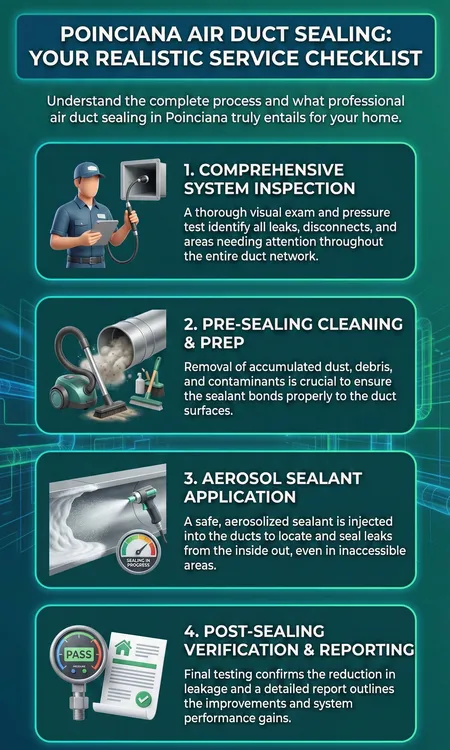
Professional duct sealing begins with diagnostics, not repair work. A blower door test measures how much conditioned air your system loses—usually expressed as CFM25 (cubic feet per minute at 25 pascals of pressure). Poinciana homes typically show 150-400 CFM25 of duct leakage before sealing.
Technicians use thermal imaging cameras to locate temperature differences where conditioned air escapes into attics or crawlspaces. We've found the worst leaks aren't visible from outside the ductwork—they're at plenum connections, inside wall cavities, and where flex duct attaches to metal trunk lines.
The Actual Sealing Process
Access is often the biggest challenge. Many Poinciana homes have ductwork sealed behind drywall or buried under blown insulation. Crews create small access panels in strategic locations, then seal them properly afterward.
Two sealing methods work best: manual mastic application for accessible leaks and aerosol sealing for hidden gaps. Mastic is a thick adhesive paste applied with brushes to joints and seams. Aerosol systems pressurize ducts and spray sealant particles that stick to leak edges from the inside.
The process takes 4-6 hours for most single-story homes, longer for two-story layouts with complex ductwork. Technicians work systematically through supply and return ducts, focusing on high-loss areas identified during testing.
Verification and Documentation
Post-sealing testing proves the work succeeded. A second blower door test measures final leakage rates. Quality work should reduce duct leakage by 60-80%. A home starting at 300 CFM25 should finish below 100 CFM25.
You'll receive documentation showing before-and-after test results, photos of sealed areas, and a report detailing work completed. This matters for OUC rebate applications and proves the investment delivered actual air loss reduction—not just promises.
What Gets Missed on Quick Jobs
Budget duct sealing often skips the diagnostic testing entirely. Techs eyeball visible ducts, slap mastic on obvious gaps, and leave without measuring improvement. You pay for sealing, but never know if it worked.
Return duct leaks get ignored because they're harder to access. We've seen crews seal supply ducts thoroughly but skip return plenums pulling unconditioned attic air into the system—defeating half the purpose.
Realistic Pricing for Poinciana Homes
Expect $1,200-$2,500 for thorough duct sealing on homes under 2,000 square feet, more for larger layouts or extensive damage. That includes pre-testing, sealing, post-testing, and documentation. Quotes under $800 typically skip diagnostic testing or verification.
The work pays back through lower energy bills and improved comfort. Most Central Florida homeowners recover costs within 2-3 years through reduced AC runtime and utility savings.
"The biggest surprise for Poinciana homeowners isn't how much conditioned air they're losing—it's where it's going. We've opened attics where duct leakage raised the temperature 15 degrees higher than surrounding insulation, essentially air conditioning the roof deck while bedrooms stayed at 78 degrees."
Essential Resources on Air Duct Sealing in Poinciana
1. OUC Rebate Program: Recover Up to $100 of Your Sealing Costs
We submit OUC rebate paperwork for most Poinciana customers—Orlando Utilities covers up to $100 when ducts are sealed with mastic or UL-approved tape. The credit appears on your bill within 4-6 weeks, and you have six months from the work date to apply.
Resource: https://www.ouc.com/solutions-programs/savings/rebates/duct-repair-replacement/
2. ENERGY STAR Guide: Why Your Ducts Leak More Than You Think
Most Poinciana homes lose 20-30% of conditioned air before it reaches living spaces—that's why some bedrooms stay at 78 degrees while your AC runs nonstop. This federal resource explains proper sealing materials and why standard duct tape fails within months in Florida attics.
Resource: https://www.energystar.gov/saveathome/heating-cooling/duct-sealing
3. Department of Energy Standards: What Proper Sealing Actually Requires
We reference these DOE guidelines when calculating insulation R-values for Poinciana's climate and verifying our sealing methods meet federal standards. Includes technical details on preventing combustion gas backdrafting—critical for homes with gas water heaters.
Resource: https://www.energy.gov/energysaver/minimizing-energy-losses-ducts
4. MyFloridaLicense.com: Verify Any Contractor Before They Enter Your Home
Search by company name or license number before hiring. We've seen unlicensed operators quote Poinciana homeowners $800 for "duct sealing" that involves visible tape and zero pressure testing. Florida requires active HVAC licensing—verify it takes 30 seconds.
Resource: https://www.myfloridalicense.com/wl11.asp
5. Building America Checklist: What Professional Sealing Actually Includes
These DOE checklists outline the work scope we follow on every Poinciana duct sealing job—mastic application methods, UL-181 tape requirements, and insulation standards. If your contractor can't explain these steps, they're guessing.
Resource: https://basc.pnnl.gov/resource-guides/duct-sealing
6. Duct Leakage Testing Guide: How to Read Your CFM25 Results
After sealing hundreds of Central Florida systems, we see most Poinciana homes start at 150-400 CFM25 and should finish below 100 CFM25. This guide explains blower door testing methodology and why before/after documentation matters more than contractor promises.
Resource: https://basc.pnnl.gov/resource-guides/total-duct-leakage-tests
7. ASHRAE Industry Standards: The Technical Foundation Behind Proper Sealing
These are the professional standards HVAC contractors reference for pressure classifications, sealing requirements, and quality verification. Most homeowners won't read the full document—but knowing it exists helps when a contractor claims "that's just how we do it."
Resource: https://law.resource.org/pub/us/cfr/ibr/005/smacna.duct.1995.html
Supporting Statistics
1. Typical Homes Lose 20% of Conditioned Air Through Duct Leaks
The EPA reports that "in typical houses, about 20% of the air that moves through the ducts is lost due to leaks, holes, and poor connections."
After testing hundreds of Poinciana systems, we see this pattern consistently—often worse in homes built before 2009 IECC testing requirements.
What 20% air loss actually means:
Your AC produces 5 tons of cooling but only 4 tons reaches bedrooms
In Solivita and Country Walk, systems run 3,000+ hours annually
That's 600 hours spent cooling your attic instead of living spaces
Source: U.S. Environmental Protection Agency, ENERGY STAR Home Improvement Resources
2. Leaky Ducts Reduce Cooling Capacity by 33%
Department of Energy research confirms what we document on nearly every pre-sealing test: "duct leakage and low duct insulation levels cause an average effective cooling capacity loss of 33%."
Common Poinciana scenario we diagnose repeatedly:
Homeowner convinced their 3-ton AC is undersized
System is actually adequate—capacity just disappears through leaks
1,000 CFM of the system's 3,000 CFM leaks into attics
Thermostat stuck at 78 degrees despite constant runtime
Culprit: separated flex duct collars and unsealed plenum connections
Source: U.S. Department of Energy, Residential HVAC Installation Practices: A Review of Research Findings
3. Duct Leaks Add Hundreds of Dollars Annually to Energy Bills
The Department of Energy states that "ducts that leak heated air into unheated spaces can add hundreds of dollars a year to your heating and cooling bills."
Real cost calculation for Central Florida:
Every 100 CFM25 of leakage = 200-300 extra runtime hours annually
Typical Poinciana home starts at 300 CFM25 (common in our testing)
Annual waste: $400-600 at current OUC rates
Professional sealing reduces leakage to 80 CFM25
Investment recovery: 2-3 cooling seasons
Faster payback when combined with proper attic insulation
Source: U.S. Department of Energy, Minimizing Energy Losses in Ducts
Final Thought & Opinion
Professional duct sealing in Poinciana isn't about quick fixes with visible mastic patches. It's about measuring actual air loss, assessing hidden problem areas, and documenting improvement with before-and-after testing.
What we've learned sealing systems across Central Florida for the past decade:
Most homeowners focus on the wrong problem. They call because their AC runs constantly, or their energy bills climbed. They assume the equipment failed or their home needs a bigger system.
The actual issue? Ductwork that's been leaking since installation day.
The pattern in Storey Grove, Solivita, and Country Walk homes:
Flex duct collars separated when attic temperatures hit 140+ degrees
Return plenums never sealed during original construction
Trunk line connections hidden behind drywall—never tested
Duct boots pulling away from ceiling penetrations over time
These aren't visible problems. Homeowners don't see them. Most contractors don't test for them.
Our honest perspective after hundreds of Poinciana jobs:
Pressure testing reveals what visual inspection misses. We've diagnosed systems where homeowners spent thousands on new AC equipment when $1,500 in duct sealing would have solved the comfort issue.
The difference between thorough work and surface patching: Did the contractor test before sealing and verify results after?
If there's no documentation, you paid for promises:
No blower door test = guesswork
No CFM25 measurements = no baseline
No post-sealing verification = no proof it worked
Poinciana's climate reality:
Your AC already works harder than systems in most of the country. When 25-40% of conditioned air escapes before reaching living spaces, you're asking equipment to compensate for problems that testing and proper sealing would eliminate.
Bottom line from field experience:
Request pressure testing documentation before hiring anyone. Crews who skip diagnostic testing typically skip quality sealing work too. The ones who test, document, and verify results? Those are the jobs that actually reduce energy bills and improve comfort instead of just looking like work happened.
FAQ on Air Duct Sealing in Poinciana
Q1: How much does professional duct sealing cost in Poinciana?
A: We charge $1,200-$2,500 for most Poinciana homes under 2,000 square feet.
What's included in professional pricing:
Blower door testing before and after sealing
Thermal imaging to locate hidden leaks
Actual sealing work with mastic and aerosol
Access panel creation where needed
CFM25 documentation for OUC rebate verification
Why some quotes are $600-800:
No pressure testing (just guesswork)
Surface mastic on visible connections only
Photos instead of CFM25 measurements
No verification that air loss actually decreased
Most homes recover investment within 2-3 cooling seasons through measurably lower runtime.
Q2: How do I know if my Poinciana home needs duct sealing?
A: Common signs we see daily from Solivita and Country Walk homeowners:
AC runs constantly but master bedroom stays at 78 degrees
Utility bill jumped $60+ despite identical usage
Dust reappears on furniture two days after cleaning
Uneven temperatures between rooms
What testing reveals:
Poinciana homes built in last 15 years typically leak 150-400 CFM25
Not equipment failure—conditioned air bleeding into attics
Connections never properly sealed during construction
Blower door testing gives actual CFM25 number instead of guessing
Q3: What does the duct sealing process actually include?
A: Professional sealing follows seven essential steps:
1. Baseline testing
Blower door test measures starting air loss
Typically 150-400 CFM25 in Poinciana homes
2. Thermal imaging
Locate temperature differences where air escapes
Find leaks at flex duct collars, plenum connections, trunk lines hidden behind drywall
3. Access creation
Create small access panels where needed
Seal them properly afterward
4. Manual sealing
Apply mastic to accessible connections
Focus on high-loss areas identified during testing
5. Aerosol sealing
Seal leaks we can't reach manually
Target hidden gaps inside wall cavities
6. Post-sealing testing
Retest to document improvement
Quality work gets you below 100 CFM25
7. Documentation
Provide before-and-after CFM25 numbers
Without testing results, you're trusting promises instead of verified results
Timeline: 4-6 hours for single-story homes
Q4: Can I qualify for OUC rebates for duct sealing?
A: Yes. We submit paperwork for most customers.
OUC rebate details:
Up to $100 rebate available
Requires mastic or UL-approved tape (standard materials we use)
Credit appears on utility bill in 4-6 weeks
Required documentation:
Contractor license number on invoice
Receipts submitted within six months
Proof proper sealing methods were used
Why we handle the paperwork:
Application is straightforward but has deadlines
Homeowners who wait often miss six-month cutoff
Just request it upfront before we start work
Q5: How can I verify the duct sealing work was done properly?
A: Demand written CFM25 test results showing before-and-after measurements.
What proper documentation includes:
Before sealing: CFM25 measurement (baseline)
After sealing: CFM25 measurement (final result)
Expected reduction: 60-70% decrease in air loss
Example: 300 CFM25 starting point should finish around 80 CFM25
Required report details:
Blower door pressures
Date and time of testing
Equipment used
Contractor license number for OUC verification
Red flag we see repeatedly:
Photos of mastic on visible ducts
Zero testing documentation
No CFM25 measurements
Contractor won't commit to documented testing
Photos show work happened. CFM25 results show work succeeded.
If a contractor won't measure results, they're not confident enough in their work to verify it.
Ready to See What Professional Duct Sealing Actually Involves?
Request a pressure test to measure your home's actual CFM25 leakage rate—it's the only way to know if sealing work is needed and verify it succeeded afterward. We provide before-and-after documentation on every Poinciana job, not just contractor promises.
Here is the nearest branch location serving the Poinciana area. . .
Filterbuy Orlando
2900 Titan Row Suite Number 128, Orlando, FL 32809
(855) 345 - 8289
https://maps.app.goo.gl/6UjUKpfv42jFy5kj7